
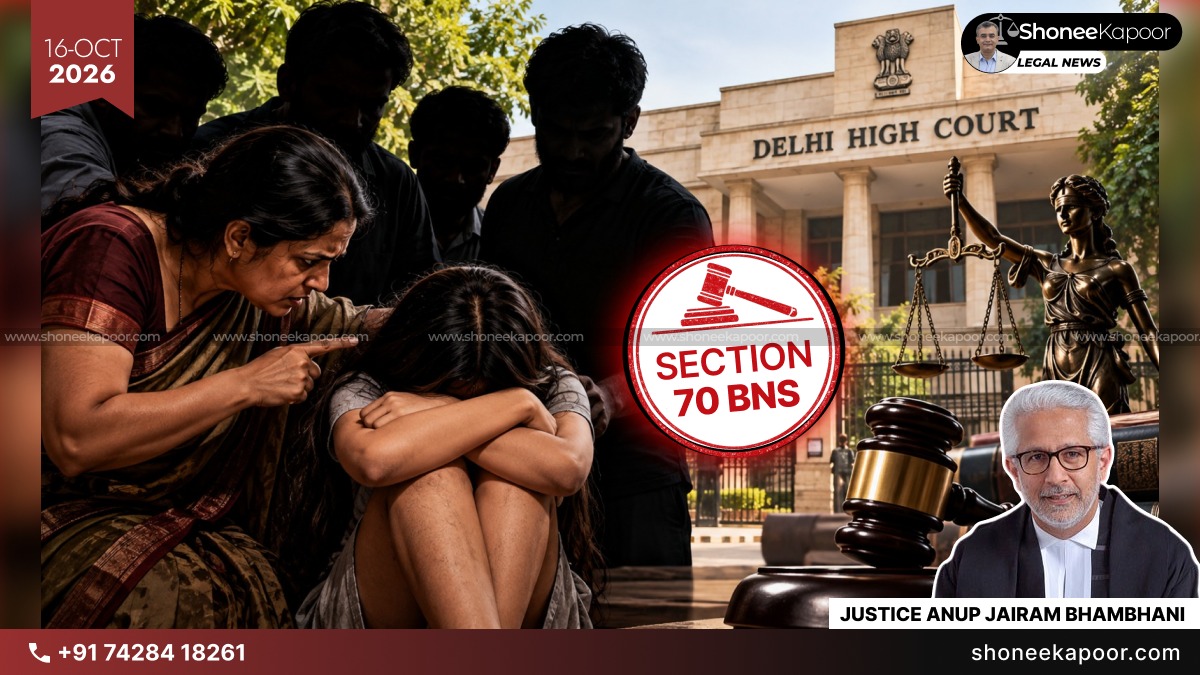
Woman Can Be Charged With Gang Rape Even Without Committing Rape Herself: Delhi High Court Rules

Curated by NEWS DESK
Editorial DeskNEW DELHI: The Delhi High Court has ruled that a woman can be charged with gang rape even if she does not physically commit rape, provided she intentionally participates in the offence or acts in furtherance of a common intention. The Court clarified that gang rape laws are not restricted to male offenders and that women can also face criminal liability for facilitating such offences.
Justice Anup Jairam Bhambhani, in his judgment delivered on October 15, 2026, held that Section 376D IPC and Section 70 BNS can apply to women who participate in gang rape, even without personally committing the physical act.
The case involved a minor girl who accused her own mother of facilitating her sexual assault by another accused. According to the victim's statement, her mother allegedly threatened to kill her if she refused to have sexual relations with the accused and remained present during the alleged assaults.
The alleged incidents occurred between December 2023 and July 2024. Interestingly, the mother had initially lodged a kidnapping complaint on July 9, 2024. However, during the police investigation, the minor disclosed allegations of repeated sexual assault.
On January 17, 2025, the trial court framed charges against the accused, including Section 70(2) BNS and Section 6 of the POCSO Act.
Read Also:- लैंगिक अपराधों से बालकों का संरक्षण अधिनियम, 2012 | POCSO Act in Hindi
Challenging the charges before the Delhi High Court, the woman argued that Section 375 IPC and Section 63 BNS define rape as an offence committed by a man. Therefore, she claimed that a woman could not legally be charged with gang rape.
However, the High Court rejected her argument, observing that the gang rape provisions introduced through the Criminal Law (Amendment) Act, 2013, use the word “persons”, which cannot be interpreted as referring only to men.
The Court explained that physically committing rape and participating in gang rape through common intention are legally different situations. A person who intentionally facilitates the offence as part of a group may also face criminal liability.
Importantly, the judgment clarified that mere presence at the crime scene does not automatically establish guilt. The prosecution must establish the accused person's participation and the necessary common intention.
The Court further explained that a woman acting alone cannot be charged with gang rape under these provisions. However, it did not decide the separate question of whether a woman acting alone could commit rape under the statutory definition.
The Delhi High Court also upheld the charge under Section 6 of the POCSO Act, recognising that the law concerning penetrative sexual assault against children provides for gender-neutral criminal liability.
Ultimately, the High Court dismissed the criminal revision petition and upheld the trial court's order framing charges. The allegations against the accused will still have to be proved during trial.
EXPLANATORY TABLE OF LAWS AND SECTIONS
| Law / Section | What It Means | Application In This Case |
|---|---|---|
| Section 375 IPC / Section 63 BNS | Defines rape, referring to a man as the offender. | The woman relied on the gender-specific definition. |
| Section 376D IPC / Section 70(1) BNS | Deals with gang rape and common intention. | The court held that women can also face gang rape charges. |
| Sections 376DA, 376DB IPC / Section 70(2) BNS | Aggravated gang rape provisions concerning minor victims. | Section 70(2) was included in the charges. |
| Section 64(2)(m) BNS / Section 376(2)(n) IPC | Punishes repeated rape of the same woman. | Included in the trial court's charges. |
| Section 351(3) BNS / Section 506 IPC | Punishment for aggravated criminal intimidation. | Relevant to alleged threats against the minor. |
| Section 137(2) BNS | Punishment for kidnapping. | Original FIR was registered under this provision. |
| Section 6 POCSO Act, 2012 | Punishment for aggravated penetrative sexual assault. | Charge against the accused was upheld. |
| Section 34 IPC / Section 3(5) BNS | Joint liability for acts done with common intention. | Used to explain group criminal responsibility. |
| Section 183 BNSS | Recording statements during investigation. | Minor's statement was recorded under this provision. |
| Sections 438, 442 and 528 BNSS | Revisional and inherent powers of the High Court. | Invoked in challenging the order framing charges. |
| Article 227, Constitution of India | High Court's supervisory jurisdiction. | Invoked in the petition. |
CASE DETAILS
| Particular | Details |
|---|---|
| Case Title | Ansxxx and Anr v. State of NCT of Delhi and Anr |
| Court | Delhi High Court |
| Bench | Justice Anup Jairam Bhambhani |
| Judgment Date | October 15, 2026 |
| Case Number | CRL.REV. P. 37/2025 & CRL.M.A. 2891/2025 |
| CNR Number | DLHC010036132025 |
| Counsel for Petitioners | Ms. Tanya Agarwal, Ms. Ritu, Mr. Akshay Singhal and Mr. Vishal M. |
| Amicus Curiae | Mr. Rohan J. Alva, assisted by Mr. Anant Sanghi |
| Counsel for State | Mr. Digam Singh Dagar, APP |
| Trial Court | Additional Sessions Judge-05 (POCSO), North District, Rohini Courts |
| Result | Criminal revision dismissed; order framing charges upheld |
KEY TAKEAWAYS
- Women Can Be Charged With Gang Rape: Delhi High Court rules that women who intentionally participate in gang rape cannot escape prosecution merely because of their gender.
- Gender Cannot Be A Shield Against Criminal Liability: A woman may face gang rape charges even without physically committing rape if the required common intention and participation are established.
- Why Are Rape Laws Still Gender-Specific? While Section 63 BNS defines rape in male-specific terms, the Court has recognised that Section 70 BNS can also cover female participants in gang rape.
- Equal Crime, Equal Accountability: The judgment exposes an important inconsistency in India's sexual offence laws, where men and women can face liability for gang rape, but the underlying rape provision remains gender-specific.
- Men Deserve Equal Protection: Justice must be gender-neutral. Criminal laws must protect every victim and hold every offender accountable, regardless of gender.
Share Your Thoughts
Comments are moderated before publication.