
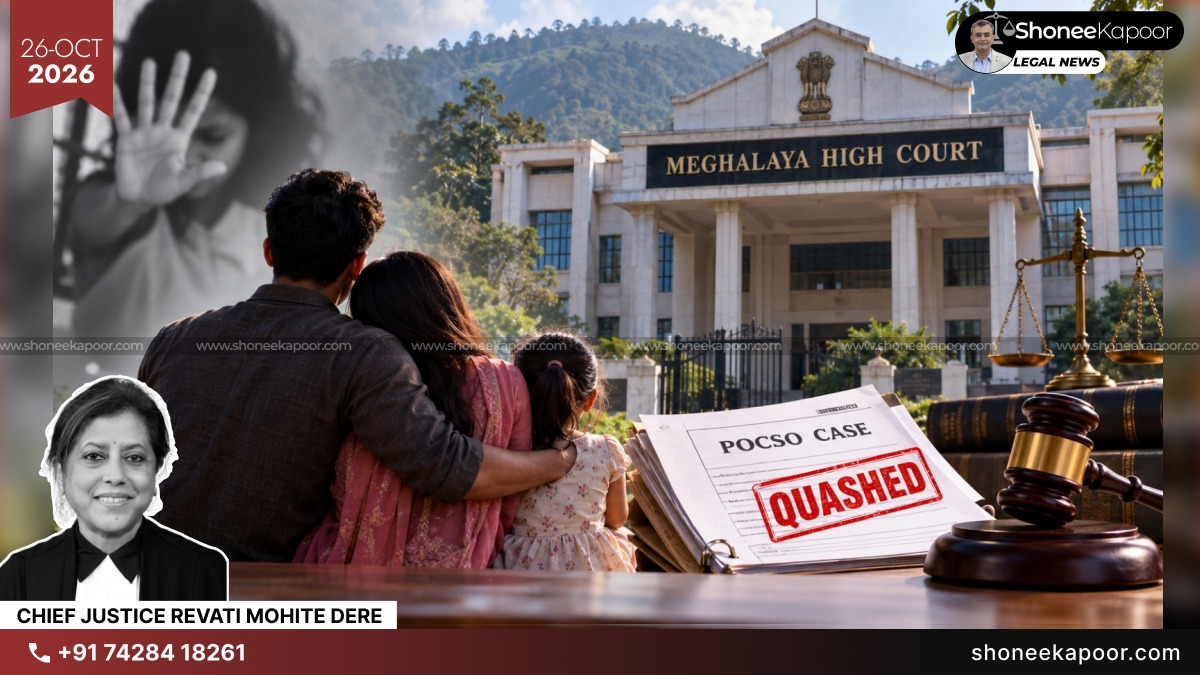
Man Faces POCSO Case Despite Living With Woman As Husband For 9 Years; Meghalaya High Court Quashes Proceedings

Curated by NEWS DESK
Editorial DeskMEGHALAYA: The Meghalaya High Court quashed a POCSO case against a man who had lived with the woman as husband and wife since 2017. The Court considered their long-standing relationship, their daughter and the woman's decision not to continue the criminal proceedings.
The man was 18 years old when the alleged offence occurred in 2017. The woman was 17 years, 11 months and 27 days old, just three days short of attaining the legal age of 18.
The police registered an FIR in 2017, followed by a chargesheet. The matter was pending before a Special POCSO Court in Meghalaya.
The man approached the Meghalaya High Court seeking to quash the FIR, chargesheet and criminal proceedings. His counsel submitted that the relationship was romantic and that the couple had been living together as husband and wife since 2017.
Read Also:- लैंगिक अपराधों से बालकों का संरक्षण अधिनियम, 2012 | POCSO Act in Hindi
The Court examined a police verification report and a report submitted by the High Court Legal Services Committee. Both reports confirmed that the couple were living together and had a daughter aged around seven to eight years.
The woman stated that the physical relationship was voluntary. She also disclosed that she had given birth to a son in December 2017, who died within a month. She later gave birth to a daughter after turning 18.
The report further confirmed that the man was caring for the woman and their daughter. The woman, who earned approximately ₹10,000 per month as a cleaner, wished to continue her family life with him.
Both the woman and her mother, who was the original complainant, raised no objection to quashing the POCSO proceedings. Her mother also confirmed that the man was taking good care of her daughter.
While examining the petition, the High Court referred to an earlier judgment concerning consensual adolescent relationships, which recognised the importance of considering the social and family circumstances in such cases.
The Court quoted:
“The ground realities in the State of Meghalaya cannot be ignored and lost sight of.”
The Court further explained that, in exceptional cases, POCSO proceedings may be quashed by consent, provided the woman's consent is genuine, informed, and free from pressure. Such decisions must depend on the individual facts and circumstances.
The earlier judgment observed:
“No doubt, we are conscious of the fact that a case under the POCSO Act is not a case against an individual, but is an offence against the society as a whole; however, the administration or enforcement of the law cannot be divorced from lived realities.”
The Court also highlighted that sending a man to jail in such exceptional circumstances could cause greater injustice to the woman and their child, particularly when the couple had already established a family.
“Where the victim and the boy are married or are living together as husband and wife (and recognised), and have a child/children, sending the boy to jail would not serve the cause of justice, rather, it would cause great injustice to the victim and the child born from the said consensual relationship, as ultimately, the aim of the law is to do justice.”
Considering the verified relationship, their daughter, and the no-objection given by the woman and her mother, the Meghalaya High Court allowed the petition.
The High Court quashed the 2017 FIR, chargesheet, and pending POCSO proceedings, ending the criminal case against the man.
The Court also directed the concerned authorities to ensure that the woman and her daughter receive applicable government welfare benefits and victim compensation within eight weeks of receiving the order. A support person was also to be appointed to assist them in obtaining these benefits.
The matter has been listed for 11 November 2026 to review compliance with the Court's welfare directions.
EXPLANATORY TABLE OF LAWS AND SECTIONS
| Law / Section | What It Means | Relevance in This Case |
|---|---|---|
| POCSO Act, 2012 | Protects children below 18 from sexual offences. | The criminal proceedings arose when the woman was legally a minor. |
| Section 4, POCSO Act | Prescribes punishment for penetrative sexual assault. | Mentioned in the Court's directions concerning victim-support schemes. |
| Section 6, POCSO Act | Prescribes punishment for aggravated penetrative sexual assault. | Also mentioned in connection with the applicable victim-support scheme. |
| Section 528, BNSS, 2023 | Preserves the High Court's inherent powers to prevent abuse of legal process and secure justice. | The cited precedent discussed the power to quash POCSO proceedings in exceptional cases. |
| Section 482, CrPC, 1973 | Earlier provision recognising the High Court's inherent powers. | Identified in the cited judgment as the predecessor of Section 528 BNSS. |
CASE DETAILS
| Particular | Details |
|---|---|
| Case Title | S v. State of Meghalaya & Ors. |
| Court | High Court of Meghalaya at Shillong |
| Bench | Hon'ble Chief Justice Revati Mohite Dere |
| Neutral Citation | 2026:MLHC:1044 |
| Case Number | Crl.Petn. No. 126/2026 |
| Petitioner's Counsel | Mr. S. Deb, LAC |
| State Counsel | Mr A.S. Dey, GA |
| Original FIR | Sadar P.S. Case No. 274(11) of 2017 |
| Trial Proceedings | Special POCSO Case No. 16 of 2025 |
| Result | FIR, chargesheet and pending POCSO proceedings quashed |
| Next Date | 11 November 2026, for recording compliance with welfare directions |
KEY TAKEAWAYS
- POCSO Case Finally Quashed: A man faced criminal proceedings despite living with the woman as husband and wife since 2017.
- Just Three Days Short of 18: The woman was three days away from adulthood, while the man was only 18 when the alleged offence occurred.
- A Responsible Man Faced Prosecution: Despite caring for the woman and their daughter, the man remained entangled in a POCSO case.
- Jailing Him Could Cause Greater Injustice: The Court recognised that imprisonment in such exceptional cases could destroy family stability and harm the woman and child.
- Justice Must Not Become Punishment: A man should not face prolonged criminal proceedings without considering genuine consent, family realities, and the injustice that continued prosecution may cause in exceptional POCSO cases.
Share Your Thoughts
Comments are moderated before publication.