
“Marriage Promise Made By Underage Man Has ‘Nil’ Evidentiary Value”: Gujarat High Court Acquits Him In Promise-To-Marry Case

Curated by NEWS DESK
Editorial DeskGUJARAT: The Gujarat High Court has upheld the acquittal of a man accused of rape on the false promise of marriage, holding that a marriage promise made when he was below the legal marriageable age had no evidentiary value as a valid marriage commitment.
On October 21, 2026, a Division Bench of Justice Ilesh J. Vora and Justice R. T. Vachhani dismissed the appeal against the man's acquittal, finding no grounds to interfere with the trial court's decision. The Court observed that a dispute between romantic partners “cannot be given colour of a criminal prosecution”.
The complainant, a college student, claimed that she had been in a relationship with the accused for nearly a year. On August 13, 2019, she went to his house after he allegedly promised to marry her once she attained the legal marriageable age of 21.
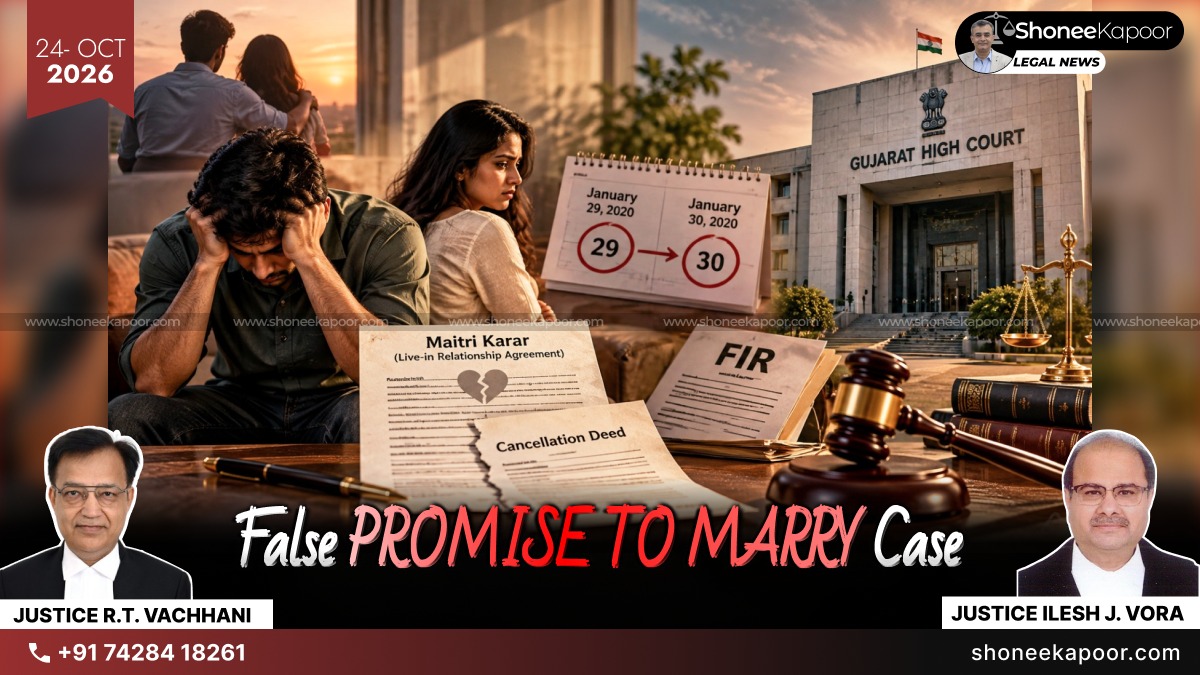
The couple later signed a Maitri Karar (live-in relationship agreement) in late 2019, agreeing to live together. At that time, neither had attained the legal marriageable age.
The woman alleged that the accused later forced her into sexual relations, physically assaulted her and demanded money. On January 29, 2020, the couple signed another document cancelling their earlier agreement. She claimed that the cancellation happened under threats.
On January 30, 2020, just one day after cancelling the live-in agreement, the woman registered an FIR alleging rape and other offences. The accused denied the allegations and maintained that the criminal case was false.
The trial court acquitted the accused, granting him the benefit of doubt. The complainant challenged the acquittal, claiming that the agreement was cancelled through “deception and threats” and that her testimony and medical evidence were not properly considered.
However, the Gujarat High Court found serious weaknesses in the prosecution's evidence.
The woman's earlier medical history recorded a romantic relationship and cohabitation but “does not describe force, coercion or deceit”. Her father and uncle admitted that she had voluntarily accompanied the accused. An independent landlord also stated that she had never complained of harassment.
The prosecution relied on the two agreements but failed to seize their originals. The Court described this as “a serious omission”.
The Court also noted that the cancellation deed contained “no recital of any beating, any threat to die, or any forcible intercourse”.
Examining the alleged false promise of marriage, the High Court noted that the accused was only 20 when the agreement was signed. It held that the “probative value of such a document”, involving “a person who was not competent” to marry, was “nil”.
The Court further held that
“the present case is not one of a promise to marry made with a dishonest intention from the very inception, so as to obtain sexual favours under the guise of such a promise”.
Regarding consensual live-in relationships, the High Court observed that where adults voluntarily live together for a substantial period, “a presumption would arise that they voluntarily chose that kind of relationship being fully aware and conversant of its consequences.”
The Court also clarified that medical and investigative evidence “can show that an incident took place or that certain steps were taken; they cannot take the place of reliable evidence of the accused’s involvement”.
The Bench further observed,
“Nowadays, it is common that women are financially independent and have the capacity to take conscious decisions of charting their life on their own terms,”
adding that a relationship dispute cannot be given the colour of a criminal prosecution.
Referring to Supreme Court principles governing appeals against acquittal, the High Court reiterated that interference is justified only “where there are compelling circumstances, and the judgment under appeal is found to be perverse”.
Finding “no perversity or legal infirmity in the appreciation of evidence,” the Gujarat High Court dismissed the appeal and upheld the man's acquittal in the rape case.
EXPLANATORY TABLE OF LAWS AND SECTIONS
| Law / Provision | What It Means | Application In This Case |
|---|---|---|
| Section 375 IPC | Defines rape, including circumstances involving consent obtained under a misconception of fact. | The prosecution alleged sexual relations based on a false promise of marriage. |
| Section 376 IPC | Prescribes punishment for rape. | The man's acquittal on the rape charge was upheld. |
| Section 90 IPC | Explains when consent given under fear or misconception of fact is not legally valid. | Relevant to whether the alleged marriage promise affected consent. |
| Prohibition of Child Marriage Act, 2006 | Generally sets the minimum marriage age at 21 for men and 18 for women. | The accused was 20 when the agreement was signed. |
| Indian Evidence Act, 1872 | Governs the admissibility and assessment of evidence. | The Court examined testimony, medical history and the two agreements. |
| Criminal appellate principles | Govern judicial interference with an acquittal. | The High Court found insufficient grounds to overturn the acquittal. |
CASE DETAILS
| Particular | Details |
|---|---|
| Court | Gujarat High Court, Ahmedabad |
| Case Title | XYZ Victim v. State of Gujarat & Anr. |
| Case Number | R/Criminal Appeal (Against Acquittal) No. 2273 of 2026 |
| Bench | Justice Ilesh J. Vora and Justice R. T. Vachhani |
| Judgment Delivered By | Justice R. T. Vachhani |
| Judgment Date | October 21, 2026 |
| High Court Case Identifier (CNR) | GJHC240527372026 |
| Appellant | XYZ Victim (Original Complainant) |
| Respondent No. 1 | State of Gujarat |
| Respondent No. 2 | Accused Man (Acquitted) |
| Appellant's Counsel | Advocate Rishabh R. Jain |
| State's Counsel | Additional Public Prosecutor L. B. Dabhi |
| Original FIR Number | First C.R. No. 11191023200089 of 2020 |
| Trial Court | Additional Sessions Judge, Court No. 7, City Civil and Sessions Court, Ahmedabad |
| Trial Court Case Number | Sessions Case No. 457 of 2021 |
| Final Decision | Appeal dismissed; man's acquittal upheld |
KEY TAKEAWAYS
- Underage Man’s Marriage Promise Has ‘Nil’ Value: A 20-year-old man’s promise to marry cannot automatically establish criminal liability.
- Broken Marriage Promise Is Not Rape: A man cannot be convicted merely because a relationship failed. Dishonest intention from the beginning must be proved.
- Consensual Relationship Cannot Automatically Become Rape: The Court considered the couple’s voluntary live-in relationship while examining the allegations.
- Allegations Alone Cannot Convict A Man: Missing original documents and weak supporting evidence raised serious doubts about the prosecution's case.
- Man’s Acquittal Upheld By Gujarat High Court: A failed relationship cannot, by itself, justify criminal prosecution for rape.
Share Your Thoughts
Comments are moderated before publication.