
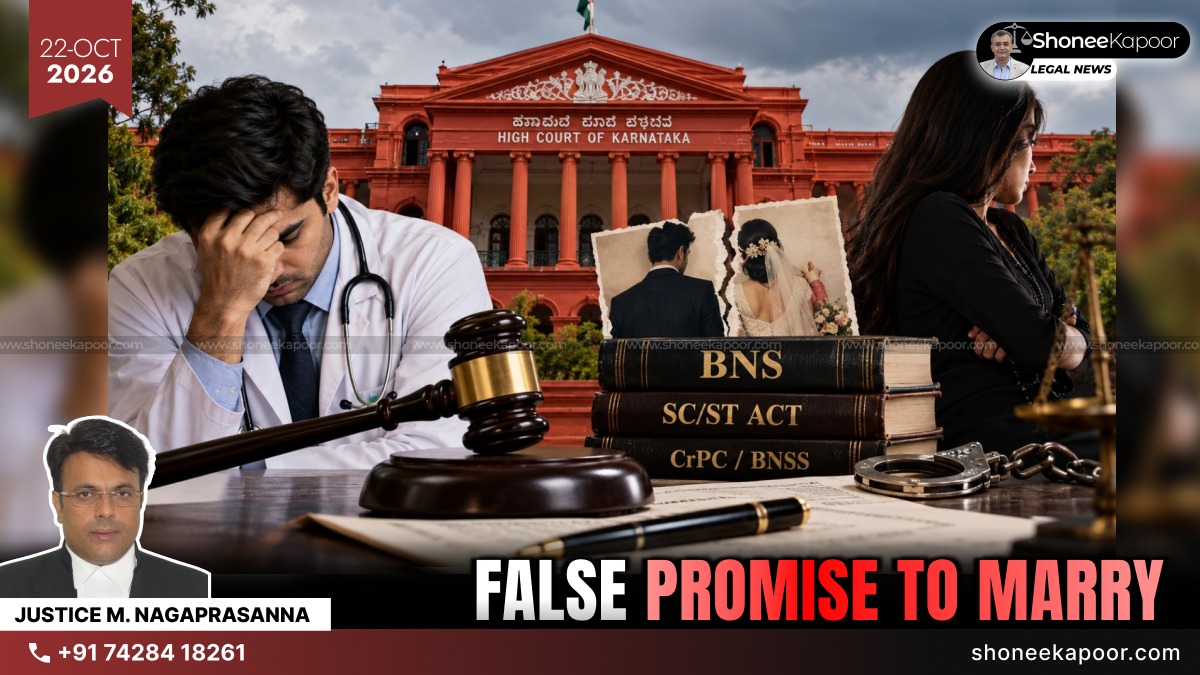
“Years Of Consensual Relationship Cannot Become An Offence U/S 69 BNS”: Karnataka HC Quashes False Promise To Marry Case Against Male Doctor

Curated by NEWS DESK
Editorial DeskKARNATAKA: The Karnataka High Court has quashed criminal proceedings against a male doctor accused of having a physical relationship with a woman on a false promise of marriage. The Court held that a long-term consensual relationship cannot automatically become a criminal offence simply because the relationship ends or the couple does not marry.
While hearing the case, Justice M. Nagaprasanna described the prosecution as an example of abuse and misuse of Section 69 of the Bharatiya Nyaya Sanhita (BNS), 2023.
The Court observed:
“…the subject case becomes a classic illustration of abuse and misuse of Section 69 of the BNS, which is now mushrooming in Courts. All consensual acts between the accused and the victim for years together are now projected to become ingredients of Section 69.
I, therefore, deem it appropriate to exercise my jurisdiction under Section 482 of the CrPC/528 of the BNSS and obliterate the proceedings to save it from becoming an abuse of the process of law and result in miscarriage of justice”.
The case involved two medical professionals who met in 2017 and developed a romantic relationship. Their consensual physical relationship began in June 2019 and continued until November 2023. After a brief separation, they resumed their relationship in September 2024.
On March 15, 2025, the woman filed a police complaint alleging that the doctor had established physical relations with her on a promise of marriage but later refused to marry her because she belonged to a Scheduled Caste.
Based on her complaint, police registered a case under Sections 69 and 115(2) of the BNS, along with provisions of the SC/ST (Prevention of Atrocities) Act, 1989.
The police filed a chargesheet on May 13, 2025, after which the doctor approached the Karnataka High Court to quash the criminal case.
The doctor's counsel argued that the relationship had continued consensually for several years and that the woman had voluntarily resumed the relationship even after their separation. Therefore, the allegations did not establish a false promise of marriage made with dishonest intention from the beginning.
After examining the facts, the High Court found that the essential ingredients of Section 69 BNS were missing. The Court clarified that the provision applies when sexual intercourse takes place through deceitful means or a marriage promise made without any intention of fulfilling it.
Read Also:- Section 69 BNS: Legal Protection or Weapon Against Men?
The Court emphasised that a failed relationship or refusal to marry cannot automatically be treated as a criminal offence when the relationship was consensual.
Referring to earlier Supreme Court judgments on false promise of marriage and consent, the Bench observed:
“The Apex Court in PRAMOD KUMAR NAVRATNA supra observes that the essential ingredient to constitute the offence under Section 376(2)(n) of the IPC for the promise of marriage is that the promise must be made with the intention of not fulfilling it at the very outset. It is reiterated that a consensual relationship, which turns sour, would not amount to a false promise of marriage”
Regarding the allegation under Section 115(2) BNS for voluntarily causing hurt, the Court found that the medical report did not show injuries supporting the accusation.
The High Court also found that the allegations failed to establish the necessary ingredients of the offences invoked under the SC/ST (Prevention of Atrocities) Act, including the allegation of sexual acts without consent.
Importantly, the Court noted that Section 69 BNS came into force on July 1, 2024, while the relationship between the parties had begun several years earlier.
Considering the circumstances, the High Court exercised its inherent powers under Section 528 of the Bharatiya Nagarik Suraksha Sanhita (BNSS) and quashed the criminal proceedings against the doctor.
EXPLANATORY TABLE OF LAWS AND SECTIONS
| Law / Section | What It Means | Application In This Case |
|---|---|---|
| Section 69, BNS, 2023 | Punishes sexual intercourse through deceitful means or a marriage promise made without intention to fulfil it. Maximum 10 years' imprisonment and a fine. | The court found the necessary elements of deceit were not established. |
| Section 115(2), BNS | Punishment for voluntarily causing hurt. | Court found no supporting injuries in the medical report. |
| Section 3(1)(w)(i), SC/ST Act, 1989 | Punishes specified intentional sexual touching without consent involving a woman belonging to an SC/ST community. | Court found the alleged sexual relationship consensual. |
| Section 3(1)(w)(ii), SC/ST Act | Punishes specified sexually suggestive words, acts or gestures towards an SC/ST woman. | Court found insufficient grounds to sustain the charge. |
| Section 3(2)(va), SC/ST Act | Provides punishment for specified scheduled offences committed against SC/ST persons or their property with the required statutory knowledge. | The related charge was quashed. |
| Section 528, BNSS, 2023 | Preserves the High Court's inherent powers to prevent abuse of judicial process and secure justice. | Used to quash criminal proceedings. |
| Section 482, CrPC, 1973 | Earlier provision recognising the High Court's inherent powers. | Referred to alongside Section 528 BNSS. |
| Section 376(2)(n), IPC, 1860 | Punished repeated rape against the same woman. | Discussed through earlier Supreme Court decisions on false marriage promises. |
| Section 420, IPC | Punishes cheating involving dishonest inducement to deliver property or alter valuable security. | Mentioned in discussion of earlier case law. |
| Sections 90 and 375, IPC | Addressed consent under misconception of fact and the legal definition of rape. | Relevant to the distinction between consent and deception in cited judgments. |
CASE DETAILS
| Particular | Details |
|---|---|
| Case Title | Dr. Ramdas @ Ramdas Patil v. State of Karnataka & Anr. |
| Court | Karnataka High Court, Bengaluru |
| Bench | Justice M. Nagaprasanna |
| Case Number | Criminal Petition No. 10701 of 2025 |
| Judgment Date | October 16, 2026 |
| Order Reserved | July 16, 2026 |
| Petitioner | Dr. Ramdas @ Ramdas Patil |
| Respondents | State of Karnataka and Another |
| Petitioner's Counsel | Senior Advocate G.L. Vishwanath and Advocate Manasa M.B. |
| State Counsel | K. Nageshwarappa, HCGP |
| Complainant's Counsel | Advocate Shantkumar N. |
| Original Case | Special Case No. 88/2025 |
| FIR | Crime No. 27/2025 |
| Final Decision | Criminal proceedings quashed under Section 528 BNSS |
KEY TAKEAWAYS
- Consensual Relationship Turned Into Criminal Case: A doctor faced serious criminal charges after a woman alleged a false promise of marriage following their years-long relationship.
- Misuse of Section 69 BNS: Karnataka High Court called the prosecution a “classic illustration of abuse and misuse” of the law.
- Failed Love Is Not A Crime: The Court clarified that a consensual relationship turning sour does not automatically establish a false promise of marriage.
- Man Faced Multiple Criminal Charges: The doctor was prosecuted under Section 69 BNS, Section 115(2) BNS and the SC/ST Act, despite the Court ultimately finding the necessary legal ingredients missing.
- High Court Protects Man from Criminal Prosecution: The Court quashed the proceedings, reinforcing that criminal law cannot be used to punish a man merely because a consensual relationship ends without marriage.
Share Your Thoughts
Comments are moderated before publication.