
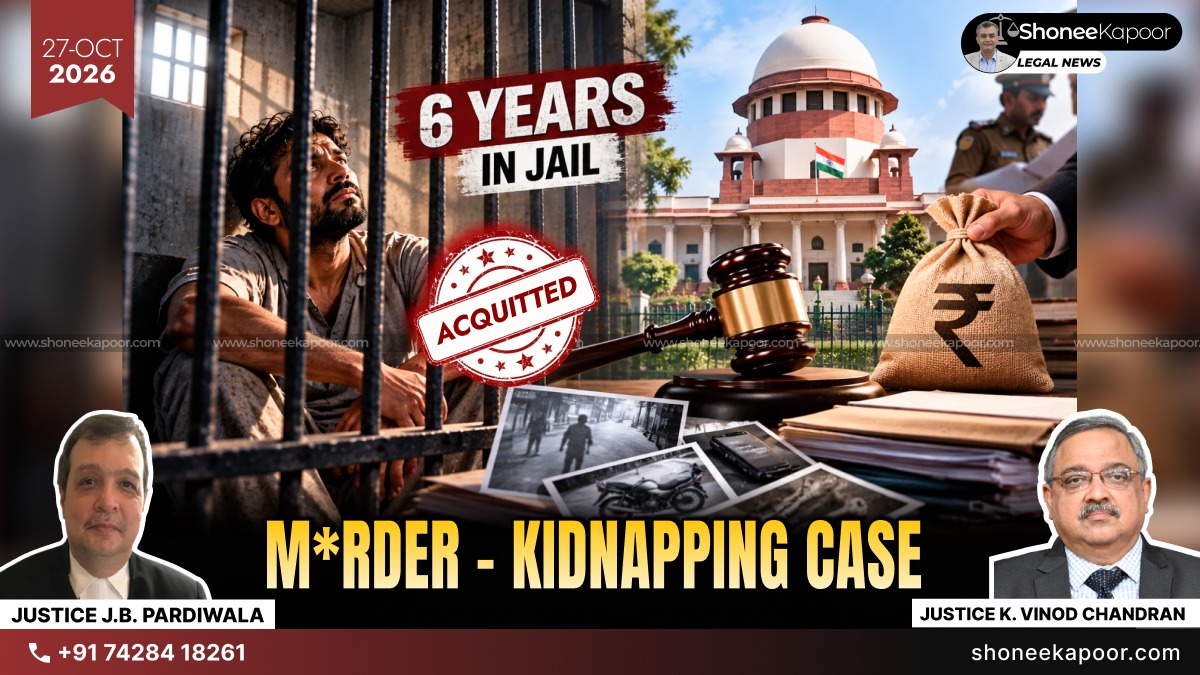
Innocent Man Jailed For 6 Years Without Evidence In Kidnapping And Murder Case: Supreme Court Slams UP Police, Orders ₹6 Lakh Compensation

Curated by NEWS DESK
Editorial DeskNEW DELHI: The Supreme Court of India has directed the Uttar Pradesh Government to pay ₹6 lakh compensation to a man who spent nearly six years in jail as an undertrial before being acquitted in a kidnapping and murder case.
A Bench of Justice J.B. Pardiwala and Justice K. Vinod Chandran, in its judgment dated 26 October 2026, strongly criticised the police investigation and prosecution, observing that the accused had lost six years of his life despite the absence of evidence against him.
The case concerned Arun alias Deepak, who had been in custody since 14 November 2019 in connection with FIR No. 367 of 2019, registered at Achhnera Police Station, Agra, under Sections 364, 302 and 201 of the Indian Penal Code (IPC).
The allegations arose after a man went missing on 18 October 2019. His father subsequently reported that unknown persons had kidnapped him. Police arrested Arun and another accused, Lalit Kishore, relying on CCTV footage, alleged confessions and recoveries.
However, the Supreme Court found that Arun was neither named in the FIR nor identified in the initial police statement under Section 161 CrPC.
The prosecution claimed that the accused had demanded ₹50 lakh as ransom and that burnt human bones and belongings of the missing person had been recovered.
However, the complainant had never reported the alleged ransom demand to the police. The recovered bones were not proved to belong to the missing person, and the medical evidence could not establish the cause or time of death.
The Court also found serious gaps in the CCTV footage, call detail records (CDR), DNA evidence and alleged recoveries.
The CCTV footage was unclear, making identification difficult. The electronic records were not supported by the required Section 65B certificate under the Indian Evidence Act, 1872.
The police had also failed to establish the ownership of the recovered motorcycle, produce the forensic results identifying the bones or prove the alleged purchase of petrol used to burn the body.
Further, the alleged recoveries were not supported by a properly recorded disclosure statement under Section 27 of the Evidence Act.
The other male accused, Lalit Kishore, died, while the third accused, Shalini, remained absconding. Arun alone faced trial.
On 23 March 2026, the Supreme Court directed the trial court to complete the proceedings within three months, considering Arun's prolonged custody. The trial eventually ended in his acquittal, as the prosecution failed to establish any of the four circumstances relied upon against him.
After examining the acquittal judgment, the Supreme Court expressed serious concern over the investigation.
The Court observed:
"It is unfortunate that despite no evidence against the petitioner herein, he was imprisoned for six years as an undertrial."
It further stated:
"Based on a slipshod investigation, a haphazard prosecution was carried out, which resulted, fortunately, in the acquittal of the accused."
Criticising the State's failure to protect an accused person's rights, the Supreme Court observed:
"The State cannot shirk from its responsibility to protect its citizens, especially when a person arraigned in a criminal case is presumed innocent until proven guilty."
The Court emphasised that investigating and prosecuting agencies must ensure justice not only for victims and complainants but also for accused persons.
Describing the consequences of the failed investigation, the Bench observed:
"Be that as it may, six years have been erased from the life of a man on the strength of a concocted story built on mere surmises and conjectures."
The Supreme Court held that such a serious failure of the criminal justice system required compensation for the accused, who had himself become a victim of the process.
The Court directed the Uttar Pradesh Government to pay Arun ₹6,00,000 within one month, observing that the amount was small compared to the six years he had spent in custody.
It further ordered that any delay in payment would attract 18% annual interest.
The Supreme Court also directed that it send a copy of its judgment to the Director General of Police and the Home Secretary of Uttar Pradesh, highlighting the need to improve police investigation practices.
EXPLANATORY TABLE OF LAWS AND SECTIONS
| Law / Section | What It Means | Relevance in This Case |
|---|---|---|
| Section 364, IPC | Kidnapping or abduction to commit murder. | Arun was accused of kidnapping the missing man. |
| Section 302, IPC | Punishment for murder. | Police alleged that the kidnapped man was murdered. |
| Section 201, IPC | Causing disappearance of evidence or giving false information to protect an offender. | Police alleged that the body was burnt to destroy evidence. |
| Section 161, CrPC | Police examination of witnesses during an investigation. | Arun was not named in the initial witness statement. |
| Section 65B, Indian Evidence Act, 1872 | Conditions for admitting electronic records as evidence, including certification requirements. | CCTV footage and CDR evidence lacked the required certificate. |
| Section 27, Indian Evidence Act, 1872 | Allows limited admissibility of information received from an accused in police custody when it leads to discovery of a fact. | Police failed to establish the necessary disclosure and discovery evidence. |
CASE DETAILS
| Particular | Details |
|---|---|
| Case Title | Arun @ Deepak v. State of U.P. |
| Court | Supreme Court of India |
| Bench | Justice J.B. Pardiwala and Justice K. Vinod Chandran |
| Judgment Authored By | Justice K. Vinod Chandran |
| Judgment Date | 26 October 2026 |
| Neutral Citation | 2026 INSC 1150 |
| Case Number | SLP (Crl.) No. 4859 of 2026 |
| Petitioner | Arun @ Deepak |
| Respondent | State of Uttar Pradesh |
| Counsel for Petitioner | Mr. Kartikeya Bhargava, AOR |
| Counsel for Respondent | Mr. Sarvesh Singh Baghel, AOR; Mr. Ramesh Thakur, Advocate; Mr. Shaurya Krishna, Advocate; Ms. Shivranjani Ralawata, Advocate |
| FIR Details | FIR No. 367 of 2019, Police Station Achhnera, District Agra |
| Custody Since | 14 November 2019 |
| Trial Outcome | Acquitted |
| Supreme Court Decision | ₹6 lakh compensation within one month |
| Interest on Delayed Payment | 18% per annum |
| Further Direction | Judgment to be sent to the UP DGP and Home Secretary |
KEY TAKEAWAYS
- Six Years of a Man’s Life Lost: Arun spent nearly six years in jail despite the prosecution failing to prove its case.
- Police Investigation Exposed: Missing DNA proof, unreliable CCTV evidence and serious investigative lapses led to his acquittal.
- ₹6 Lakh for Six Lost Years: The Supreme Court ordered compensation, but can money restore a man's lost freedom and dignity?
- Accused Men Have Rights Too: The Supreme Court stressed that justice must protect the accused, not just victims and complainants.
- Accountability for Wrongful Imprisonment: A man lost six years of his freedom due to a flawed investigation, highlighting the urgent need for police accountability and protection of innocent men’s rights
Share Your Thoughts
Comments are moderated before publication.