
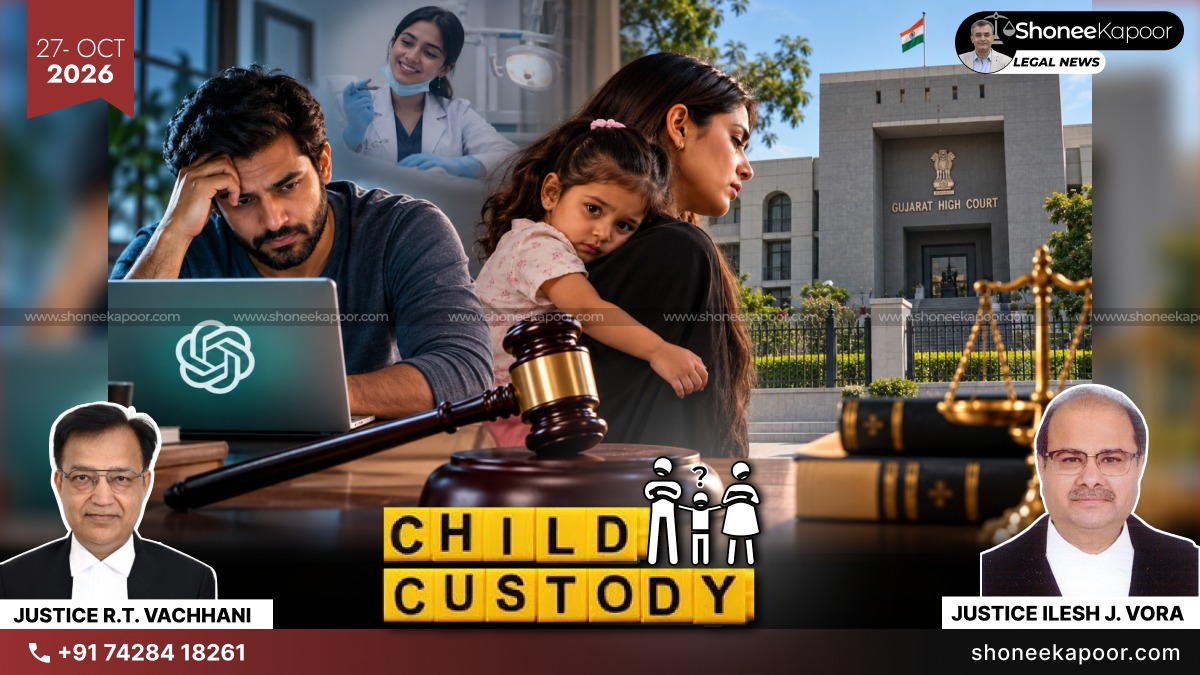
Child Custody Case | Excessive ChatGPT Use By Husband Sparks Marital Dispute: Gujarat High Court Rejects His Habeas Corpus Plea

Curated by NEWS DESK
Editorial DeskGUJARAT: The Gujarat High Court has dismissed a father's habeas corpus petition seeking custody of his two-year-old daughter after his wife allegedly took the child without his consent. The wife claimed that her husband's excessive ChatGPT use had contributed to their marital problems.
A Division Bench of Justice Ilesh J. Vora and Justice R. T. Vachhani, in its judgment dated 8 October 2026, held that the child's custody with her mother could not be considered illegal merely because the father wanted her return.
The couple married on 4 September 2016 and welcomed their daughter in May 2024. According to the husband, his wife left their matrimonial home on 28 May 2026 and left the child in his care.
He alleged that on 7 August 2026, his wife took their daughter without his knowledge or consent. He further claimed that she subsequently denied him access to the child.
The father approached the police and later filed a complaint before the Judicial Magistrate in Surat, alleging offences including kidnapping, extortion, theft and wrongful confinement.
However, the Magistrate declined to order the child's immediate production and observed that custody should be decided through the appropriate legal proceedings.
In her reply to the husband's legal notice, the wife denied his allegations and claimed that he had become excessively dependent on ChatGPT since January 2025, even for routine decisions.
She further alleged that he had developed a one-sided romantic attachment towards a dentist and that his behaviour had affected their marriage.
The judgment recorded the wife's allegation that the husband used expressions such as "mother manipulator", "daughter thief", "mama extortionist", and "father spineless".
The wife also made allegations concerning his behaviour during a domestic disagreement. These claims were recorded as part of the matrimonial dispute and were not independently established as findings of misconduct.
The husband argued that his daughter had been living with him before being taken away and that denying him access was harmful to their relationship. He submitted that he could financially support the child.
While examining the custody dispute, the High Court referred to the Supreme Court's decision in Sarita Sharma v. Sushil Sharma, which observed:
"When the minor child is in custody of the mother, such custody cannot be considered unlawful merely because the father seeks custody... What would be in the interest of children requires a full and thorough enquiry"
The Bench also relied on Tejaswini Goud v. Shekhar Jagdishprasad Tiwari, explaining that habeas corpus is an extraordinary remedy and disputed custody claims generally require examination before a competent court.
The High Court held that the child's welfare must take priority over either parent's legal claims. It found that the allegations and counter-allegations required detailed evidence rather than a summary decision through a habeas corpus petition.
The Court refused to change the daughter's existing custody and dismissed the father's petition at the admission stage.
However, the Bench clarified that it had not decided either parent's permanent or interim custody rights. Both parties remain free to approach the competent court for appropriate relief.
EXPLANATORY TABLE OF LAWS AND SECTIONS
| Law / Section | What It Means | Relevance in This Case |
|---|---|---|
| Article 226, Constitution of India | Empowers High Courts to issue writs, including habeas corpus. | Father approached the High Court seeking production and custody of his daughter. |
| Section 175(3), BNSS, 2023 | Allows a Magistrate to order police investigation subject to statutory requirements. | Father filed a private complaint before the Surat Magistrate. |
| Habeas Corpus | Legal remedy against unlawful detention or custody. | Court held that the daughter's custody with her mother was not illegal. |
| Hindu Minority and Guardianship Act, 1956 | Governs natural guardianship of Hindu minors, subject to their welfare. | Cited as an ordinary legal remedy for guardianship disputes. |
| Guardians and Wards Act, 1890 | Provides a legal framework for guardianship and custody proceedings. | Court referred to this law as an appropriate route for detailed custody examination. |
CASE DETAILS
| Particular | Details |
|---|---|
| Case Title | Nirav Pawan Chugh v. State of Gujarat & Ors. |
| Court | Gujarat High Court, Ahmedabad |
| Bench | Justice Ilesh J. Vora and Justice R. T. Vachhani |
| Judgment Date | 8 October 2026 |
| Case Number | R/Special Criminal Application (Habeas Corpus) No. 14283 of 2026 |
| Judgment Identifier | GJHC240742232026 |
| Counsel for Father | Mr. Mokshay R. Vyas and Mr. Darshan K. Bhojak |
| For State | Mr. L. B. Dabhi, APP |
| Petitioner | Nirav Pawan Chugh (Father) |
| Respondent Mother | Mansi Nirav Chugh |
| Child | Minor daughter, approximately 2 years and 3 months old |
| Result | Father's habeas corpus petition dismissed at admission stage |
| Direction | Parties may pursue appropriate legal remedies; permanent and interim custody claims remain undecided |
KEY TAKEAWAYS
- Father's Custody Plea Dismissed: Gujarat High Court refused to grant custody of his two-year-old daughter through habeas corpus.
- Father Alleged Denial of Access: The husband claimed his wife took their daughter without consent and prevented him from meeting her.
- ChatGPT Addiction Allegations: Wife blamed husband's excessive AI use and alleged behaviour for their marital dispute.
- Mother's Custody Not Illegal: Court held that a child living with her mother cannot automatically be treated as unlawfully detained.
- Father's Rights Remain Open: Despite dismissal, the father can seek custody and visitation through proper legal proceedings.
Share Your Thoughts
Comments are moderated before publication.