
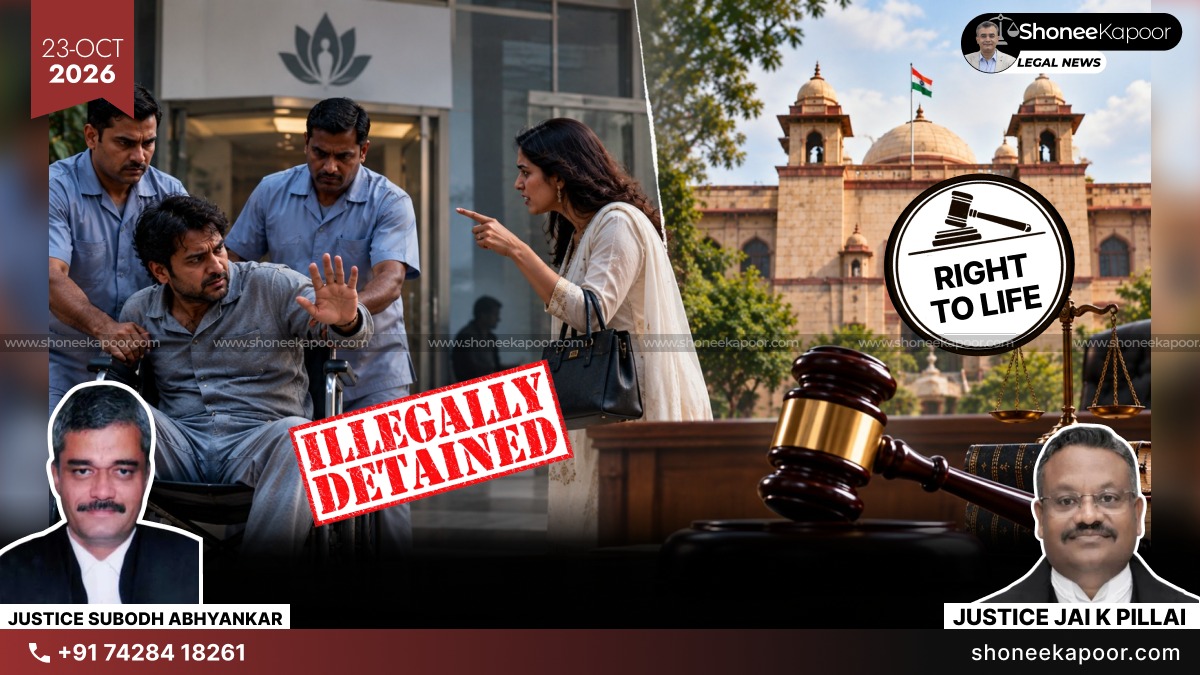
Wife Can't Forcibly Detain Husband At De-Addiction Centre Without His Consent Or Medical Grounds: MP High Court Orders His Release

Curated by NEWS DESK
Editorial DeskMADHYA PRADESH: The Madhya Pradesh High Court has ordered the immediate release of a husband who was forcibly confined in a private rehabilitation centre allegedly at his wife's request. The Court declared his detention illegal, holding that a spouse's consent alone cannot justify forced confinement without valid legal or medical grounds.
A Division Bench of Justice Subodh Abhyankar and Justice Jai Kumar Pillai, in its order dated October 7, 2026, allowed a habeas corpus petition filed by the husband's brother under Article 226 of the Constitution.
The couple was living separately in Indore's Rau area due to ongoing matrimonial disputes.
The husband had earlier lodged two police complaints, NCR No. 32/2025 and NCR No. 165/2025, alleging physical assault and harassment by his wife and her family members. He had also undergone medical examination and treatment.
On September 7, 2026, the wife allegedly called her husband to her residence and subsequently took him to a private de-addiction and rehabilitation centre, where he was admitted against his wishes.
The next day, his brother visited the centre and requested his release. However, the centre refused. He then approached the police, but no effective action was taken.
The brother moved the High Court, alleging that the husband was illegally detained despite not being a habitual drug addict or requiring forced rehabilitation.
He further alleged that the wife had colluded with the rehabilitation centre to restrict her husband's personal liberty with an intention to take over his property.
The petitioner also informed the Court that his brother suffered from left-side paralysis and required regular neurological treatment. He argued that continued confinement in a centre lacking proper medical facilities posed a serious risk to his health.
Opposing the petition, the wife's counsel claimed that the husband was a habitual drug addict who frequently physically assaulted her while intoxicated.
The wife maintained that she admitted him to the centre to protect her life and save their marriage. The respondents also claimed that the husband enjoyed "free will" at the facility.
The High Court examined an independent Medical Board report dated October 1, 2026, which stated:
"At present is having no gross psychopathology on Mental State Examination; however, he is having left side residual hemiparesis on physical examination. For which opinion of a neurologist is advised."
The Court found that the medical report did not establish any psychiatric condition or addiction justifying the husband's forced admission to the rehabilitation centre.
The Bench observed that an adult of sound mind has the right to decide matters of personal liberty and medical treatment.
It further held that a private rehabilitation centre cannot function as a detention facility merely on the basis of a spouse's consent form.
Rejecting the respondents' argument, the Court found the claim of "free will" contradictory, as the rehabilitation centre had refused to release the husband despite his brother's request.
The Court held that the husband's forced confinement was illegal and violated his fundamental right to life and personal liberty under Article 21 of the Constitution.
Accordingly, the High Court declared the detention unlawful and directed the police authorities and rehabilitation centre to release the husband immediately.
The Bench also allowed him to live wherever he wished, including with his brother. The wife was permitted to seek his future admission to a de-addiction centre only if an independent Medical Board found a medical necessity.
EXPLANATORY TABLE OF LAWS AND SECTIONS
| Law / Section | What It Means | Application In This Case |
|---|---|---|
| Article 21, Constitution of India | Guarantees the fundamental right to life and personal liberty. | The Court held that forcibly confining the husband without lawful justification violated Article 21. |
| Article 226, Constitution of India | Empowers High Courts to issue writs for enforcement of fundamental and other legal rights. | The husband's brother approached the High Court under Article 226 seeking his release. |
| Writ of Habeas Corpus | A constitutional remedy used to challenge unlawful detention and secure a person's liberty. | The High Court allowed the petition and directed the husband's immediate release. |
CASE DETAILS
| Particular | Details |
|---|---|
| Case Title | R.P. v. State of Madhya Pradesh and Others |
| Court | Madhya Pradesh High Court, Indore Bench |
| Bench | Justice Subodh Abhyankar and Justice Jai Kumar Pillai |
| Date of Order | October 7, 2026 |
| Case Number | Writ Petition No. 39187 of 2026 |
| Neutral Citation | 2026:MPHC-IND:28372 |
| CNR Number | MPHC020377132026 |
| Petitioner's Counsel | Advocate Monesh Jindal |
| State's Counsel | Government Advocate Amit Bhatia |
| Wife's Counsel | Advocate Shubham Mandil |
| Final Decision | Husband's detention declared illegal; immediate release ordered |
KEY TAKEAWAYS
- Wife's Consent Is Not Supreme: A wife cannot forcibly confine her husband in a rehabilitation centre merely by signing a consent form.
- Husband's Complaints Preceded Detention: The husband had earlier filed two police complaints alleging physical assault and harassment by his wife and her family.
- Wife's Allegations Failed to Justify Detention: The Medical Board found no condition warranting forced rehabilitation, undermining the justification for his confinement.
- High Court Protects Husband's Liberty: The Court declared his detention illegal and ordered immediate release under Article 21 of the Constitution.
- Marriage Does Not Give Ownership Over Husband: A wife's allegations cannot override her husband's fundamental rights. His liberty is not hers to control
Share Your Thoughts
Comments are moderated before publication.